

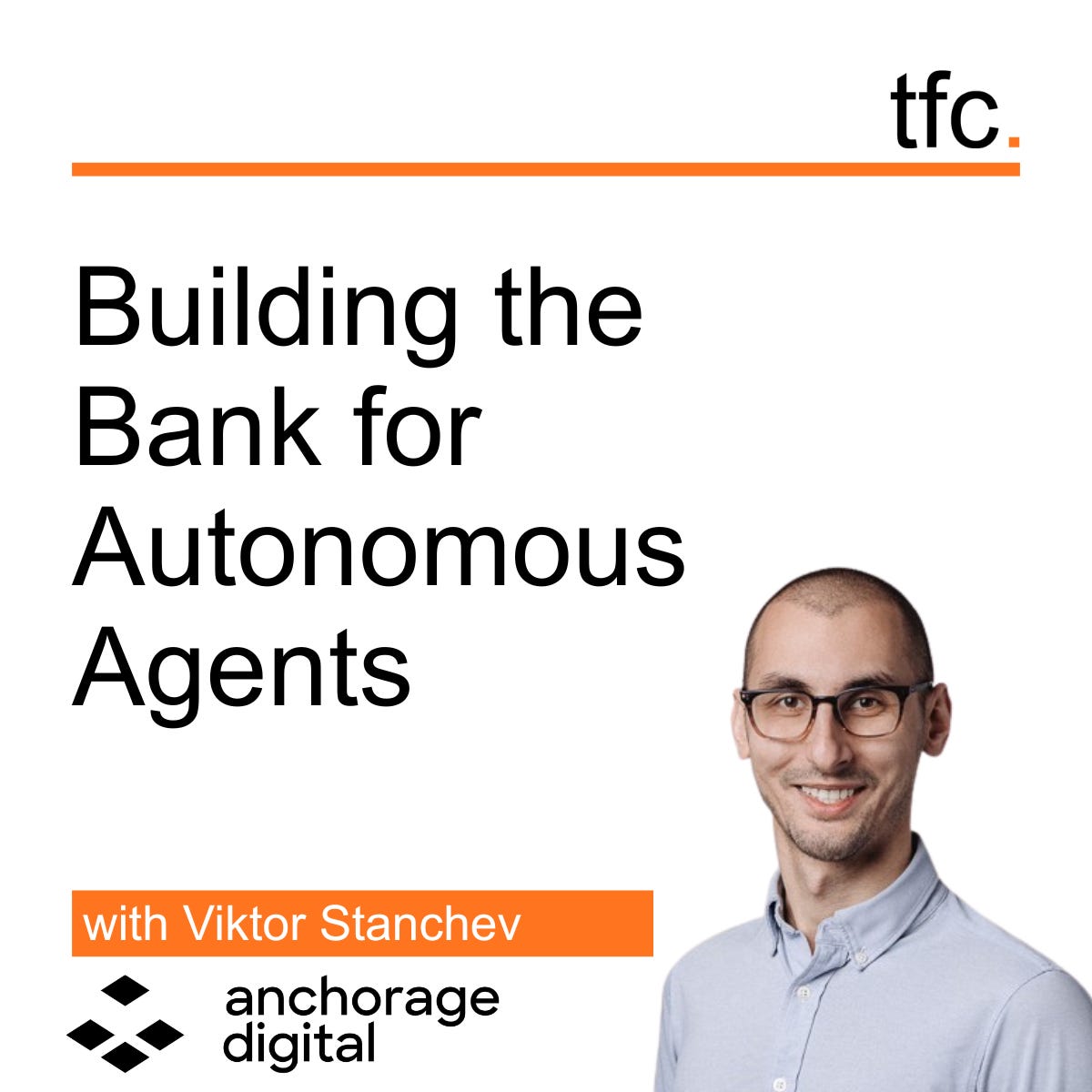
My next guest is Viktor Stanchev, who joined Anchorage Digital as the sixth employee in 2018, pre-product, on nothing but a vision and the people he’d come to trust. Viktor had done crypto early with TX Bits, then made a deliberate decision to go deep on systems and Linux at Docker rather than chase the bull market into Coinbase. When his Docker colleagues Nathan McCauley and Diogo Monica walked out the door to start something new, he asked them what was next, and joined Anchorage Digital the day after.
Eight years and a $4.2B valuation later, he’s still there, now resetting the clock entirely to build out Anchorage Digital’s agentic banking product that has just launched. We talked about the ship of Theseus with regards to their architecture, staying somewhere for eight years, how to refactor safely in the age of agents, and what it means to build infrastructure for AI agents that will one day become true financial actors.
Ben: You’d actually stepped away from crypto on purpose. You did TX Bits early, then chose Docker over something like Coinbase. Why?
Viktor: I’d done crypto things back in the day, but then I decided not to go into crypto, maybe because the bull cycle had ended. I wanted to learn how to be a better engineer, how to build really good systems, get really deep into Linux and all of that. That’s how I ended up at Docker instead of somewhere like Coinbase right after graduating. Security was a similar thing for me – I’ve always been interested in it, but I decided not to go into the industry because I didn’t like the culture of security itself. I wanted to do things that had to be secure, not just work in security.
Ben: So how did Anchorage Digital actually come together? How did you join?
Viktor: I kept an open dialog with Nathan and Diogo while I was at Docker, so I knew what they were capable of, how they thought, how they operated. They’re very impressive. When they left Docker, I asked them the next day what’s going on, what they are doing next. That’s when I learned about the formation of Anchorage Digital. I was at the right place at the right time. I’d already done crypto, I’d already done security stuff for a long time, and this was a chance to be an engineer building things that have to be secure. The only thing they had to convince me of was that there was a market for this thing. Turns out there was a very good one.
Ben: You joined pre-product and stayed through the OCC charter, a $4.2B valuation. Walk me through what you owned in year one versus today.
Viktor: The biggest difference is just the size, the number of people, engineers, products, scale. In the first year it actually took quite a bit of time before we got our first client. It was very fun just building things out and operating in a small team. Over time I had to adapt and do more. I had to lead teams. I had to set a technical direction. And I had to learn how to influence without being a manager, how to convince people, how to sell my ideas, how to slowly move us in the right direction, and do that at a larger scale as the org grew.
Right now I’m leading our agentic banking product, which is kind of resetting the scale again, a very small team, an early stage product in a fresh codebase, designed for velocity and agentic engineering from the ground up.
Ben: In crypto, one bad mutation can be catastrophic and irreversible. How did you manage the tension between moving fast and the correctness bar?
Viktor: One thing we’ve had from the beginning is that our HSM code base is separate from our backend. There’s a very clear boundary between the HSM, the hardware security module that enforces the rules about how you can spend your crypto, and the backend. We treated the backend as untrusted. That gave us a lot of leeway to move fast on the backend while being very careful and deliberate about how we evolved the HSM. The security model runs between the HSM and the iOS apps our clients use, which means we don’t have to trust the backend. So we just had to maintain the quality of that HSM code base, which was easier because it was smaller, and we always reviewed it deeply. This was pre-LLMs, when you had to do all the hard work yourself.
Ben: You’ve been there eight years. What’s actually kept the culture and the quality intact through all that scale?
Viktor: We’ve grown significantly over the years. One of the biggest benefits of staying in one place so long is you get to really see the outcomes of different decisions. One of the biggest inflection points was hiring a very good head of engineering – someone with decades of industry experience who knows how to drive a team, evaluate people, have the hard conversations, and is deeply technical enough to dive into the chaos and make sense of it. Those people are so hard to find, but when you find one, they make an enormous impact.
Everything comes down from high-quality leadership, because the people at the top choose the next level, and the next, and so on. It’s a people problem at the end of the day. The people are driving the tech.
Ben: Let me put the spotlight on you. What are you proudest of?
Viktor: My favorite times have been solving a hard cross-functional problem. One example is Porto, our self-custody product. It’s essentially all the existing infrastructure behind Anchorage Digtial, but packaged as a self-custody product.
Porto simplifies onchain participation by combining institutional-grade hardware security with native DeFi execution and you remain in control of your keys, which is what makes it self-custody. But you still get the existing tech, the quorums, the way you control and move assets and sign transactions. I had to be creative. Even though it was tempting to start rewriting things to get a non-custodial product, we ended up defining what self-custody means and then meeting that definition at the technical layer without changing too much.
Ben: Reflecting back, what would you tell someone evaluating joining as one of the first ten engineers at a company?
Viktor: I got to skip that research, because I already knew the founders. But that’s exactly the thing to evaluate: not just the founders’ skills, but their attitudes, the culture, their character — enough to mentally extrapolate what it would look like for them to run a company. It’s the same thing investors do when they evaluate an early bet.
Ben: Set the company’s success aside for a second, just the role. You joined early, without founder risk but maybe without founder equity, and got the experience as it de-risked. Did you ever think about that tradeoff?
Viktor: Constantly. Even now I think about the opportunity cost. But would I have reached this level if I’d joined a more established or corporate company? I got to grow so much while growing with the startup. So one day when I am ready to make the jump, I’ll be able to make a bigger jump than I would have at a bigger company. The best part has been the trust, having the freedom from the founders and the company to experiment and do bigger and bigger things. You have to earn that over time, and it’s really hard to join a new company and have that kind of trust to experiment and grow.
Ben: Before we wrap, tell me about what you’re building now. Agentic banking.
Viktor: We’re building a way for people to run agents that can make and receive payments. It’s a crazy space right now, everyone is building things, and the agents themselves are becoming more and more capable.
We’re building up the infrastructure so that when agents are ready to run completely autonomously and become true financial actors, when they start making consequential decisions, there’s a regulated, well-controlled place for them to go and do that.
The interesting thing about Anchorage Digital being part of this is that we already have so much trust, so much focus on security, such high-quality controls and compliance. As this space moves from DeFi and wild-west peer-to-peer transactions toward institutional players and regulation, we’re there to support the agent ecosystem when it comes to payments and banking. We announced our Agentic Banking offering on May 5, 2026; we’re running a pilot with a small group of users, and we’re working through the compliance and regulatory pieces to hit GA later this year.
Viktor’s story is a reminder that some bets aren’t bets at all when you already know the people. Eight years in, he’s watched nearly every original line of code get replaced one piece at a time, everything except the language and the security boundary he insisted on from day one. And now, having seen the whole arc from six people to two hundred engineers, he’s doing the thing founding engineers can’t help but do: resetting the clock, picking up the smallest possible team, and building the next thing from scratch.